Houseplant Identifier
Identify a mystery indoor plant from its leaves, stems, and growth habit
Identification form
Upload houseplant photos
Clear, well-lit images help the AI identify it more accurately.
How to Use the Houseplant Identifier
- 1
Show the Entire Plant
Photograph the whole houseplant in natural, even light. Include the pot and a familiar object for scale so the tool can read its size, overall outline, and trailing, climbing, rosette, or upright habit.
- 2
Capture a Mature Leaf
Add sharp views of the top and underside of a healthy mature leaf. Keep its tip, base, margin, veins, color, variegation, gloss, hairs, or texture visible rather than filling the frame with one damaged patch.
- 3
Include the Stem and Node
Photograph where a leaf stalk meets the stem, plus aerial roots, sheaths, canes, spines, bulbs, or offsets if present. Add any flower and new leaf, because these details can separate houseplants with similar foliage.
- 4
Add Indoor Context
Enter the location and date, then note where the plant sits, how it grows, its approximate height, and any old label or purchase history. Context can help narrow an ornamental plant that is commonly sold under several names.
- 5
Review the Likely Match
Select "Identify houseplant" and compare the suggested name with the supporting and conflicting clues in the result. Check alternative matches and add a clearer angle when the visible evidence does not separate them.
Ready to identify it?
Upload one or more clear photos to get started.
Identify a Houseplant From Photos
An unlabeled gift, inherited pot, or faded nursery tag can turn an ordinary care question into a naming puzzle. The houseplant identifier starts with the evidence already in front of you: the plant's outline, mature foliage, stems, nodes, and any flowers. Upload several clear views and add what you know about its size and indoor setting. The result offers a likely match to investigate, not a guaranteed identity.
Begin with context rather than a single attractive leaf. A full view shows whether the plant trails from a basket, climbs from nodes, grows as a basal rosette, produces upright canes, or branches like a small tree. Then show one healthy mature leaf from above and below. Leaf base, tip, margin, veins, sheen, thickness, hairs, and variegation can all carry more information than color alone.
A third photo should connect leaf to plant. Include the petiole, node, new growth, sheath, aerial root, offset, or bulb-like base where relevant. These less glamorous structures often resolve look-alikes that share the same heart-shaped or striped foliage. Flowers are valuable when present, but you do not need to wait for a bloom to begin.
After receiving a match, compare the explanation with the physical plant. Supporting traits show why the suggestion fits; conflicting traits and alternatives reveal what remains uncertain. If a critical node or underside is missing, take that specific follow-up view instead of repeatedly submitting the same angle.
Leaf, Stem, and Growth Clues That Matter
Houseplant identification works best as a combination of clues. Start with growth habit: trailing pothos, clumping peace lilies, cane-forming Dracaenas, rosette-forming bromeliads, and woody Ficus plants occupy very different structural categories even when a cropped leaf looks similar. Note whether stems climb, creep, branch, or emerge directly from the potting mix.
Next read the leaf precisely. Is it heart-shaped, arrow-shaped, oval, strap-like, lobed, or divided? Look for a smooth, toothed, wavy, or spiny margin; parallel or netted veins; and a glossy, velvety, fuzzy, leathery, succulent, or paper-thin surface. Record how leaves are placed on the stem and whether their bases are symmetrical. Spots, stripes, silver zones, colored veins, and contrasting undersides can narrow a group, though decorative markings alone may only indicate a cultivar.
Stem and node details are especially helpful among tropical foliage plants. Show whether the leaf stalk is round, flattened, grooved, or winged, and whether emerging leaves have a persistent or papery sheath. Aerial roots, swollen joints, canes, spines, tendrils, and offsets are useful structural evidence. For palms and ferns, show the complete frond and how its leaflets or divisions are arranged.
Separate stable features from temporary condition. Low light may stretch the spaces between leaves; age can alter leaf size and the presence of splits; damage can remove margins or change color. Use a healthy mature part as the main reference, then include unusual growth as additional context. The strongest likely match explains several independent traits at once rather than depending on one familiar pattern.
How to Check Common Houseplant Look-Alikes
Common names make indoor plant identification harder because shops and owners may reuse one name for unrelated plants. Pothos, philodendron, and satin pothos are a classic example. Instead of choosing by a heart-shaped silhouette, compare the leaf stalk, node, emerging leaf, texture, and variegation. Golden pothos, heartleaf philodendron, and Scindapsus can resemble one another from across a room while differing clearly in those close structural views.
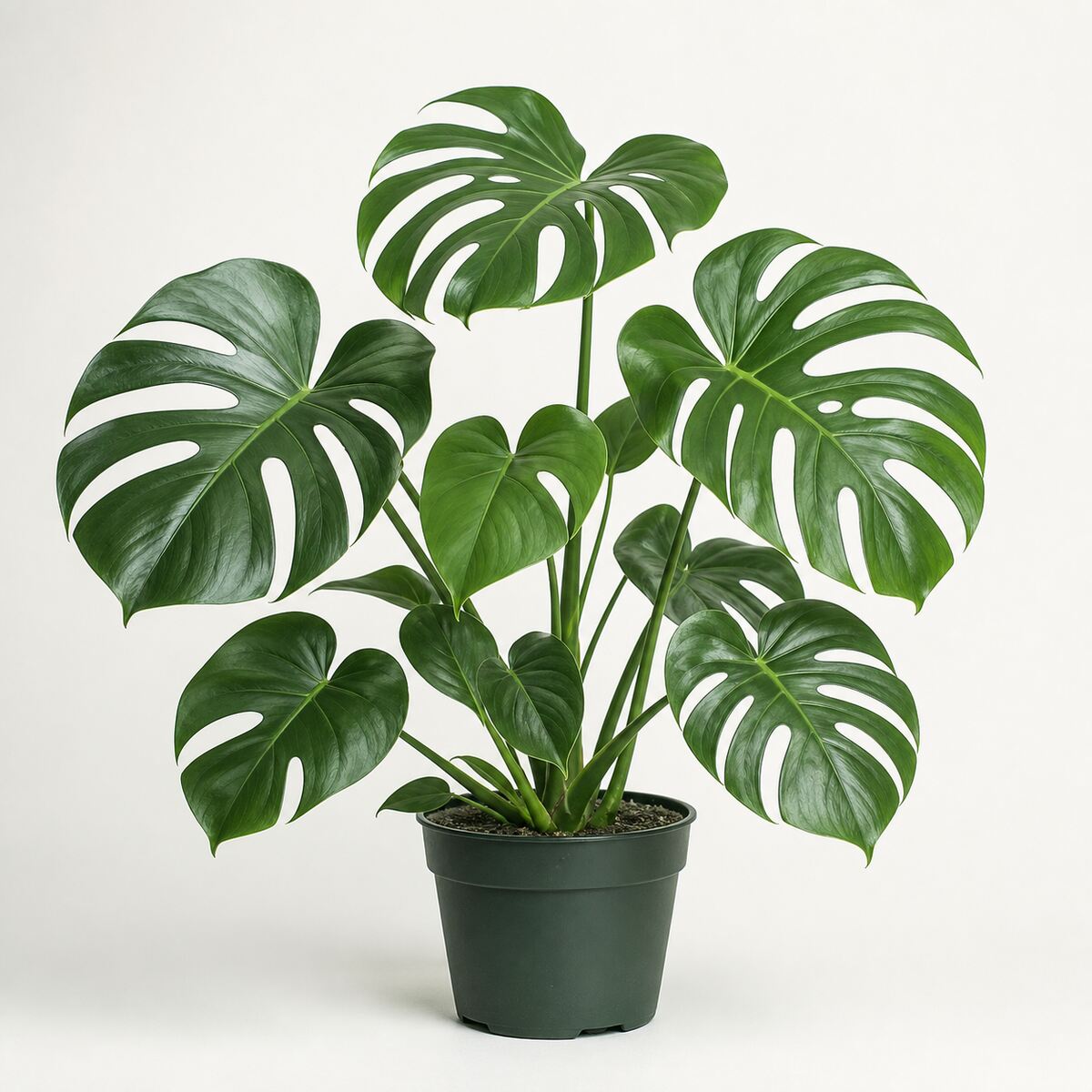
Split leaves create another naming trap. A mature Monstera may form both cuts that reach the edge and enclosed holes called fenestrations. Rhaphidophora tetrasperma commonly develops a compact series of edge splits, while plants marketed under “split-leaf philodendron” may belong to a different growth form altogether. Young specimens complicate the comparison because they can lack the mature leaf divisions people expect. Photograph several ages of leaf, the petiole, and a node before settling on a species.
Patterned prayer-plant relatives require the same discipline. Maranta, Goeppertia, Ctenanthe, and Stromanthe may share feathered bands, spots, or purple undersides, and named cultivars multiply the possibilities. Show the complete clump or trailing stem, both leaf surfaces, the stalk, and the way a new leaf unfurls. A family or genus suggestion can be more useful than an over-specific cultivar name that the photos cannot support.
Retail and older botanical names add a final layer. Snake plants are still widely sold under Sansevieria even though many references place them in Dracaena, and familiar sales labels may combine multiple taxa. Check whether a result presents a scientific name, common alias, former name, or cultivar. When names conflict but the morphology agrees, the difference may be terminology rather than a different plant.
Turn a Likely Name Into Better Care Decisions
A useful houseplant name narrows the care questions; it does not produce one fixed routine. Once you have a likely match, use it to research the plant's preferred light range, moisture pattern, humidity, temperature, potting medium, and mature growth habit. Then adjust that guidance to the actual room, container, season, and condition of the plant.
Avoid translating a broad phrase such as “low light” into “no light,” or a generic watering interval into a calendar rule. Window direction, distance from glass, day length, pot material, root volume, and airflow can change how quickly a growing medium dries. Check the medium and the plant rather than assuming every specimen with the same name needs water on the same day. Good drainage matters differently from frequent watering, so consider both the container and the substrate.
Identity also helps you interpret growth. A climbing plant may produce larger, more divided leaves with support, while a trailing stem may stay smaller. Some variegated plants need enough light to maintain balanced growth, yet abrupt exposure can damage foliage. A likely species gives you the right questions to ask, but gradual changes and observation remain important.
Keep identification separate from diagnosis. Yellow leaves, crisp edges, spots, webbing, distorted new growth, or a declining stem may justify closer inspection, but none points to a single cause by itself. Document the whole plant, roots when safely visible, both leaf surfaces, and recent care changes. If decline continues or treatment carries risk, ask a qualified nursery or horticultural professional to examine the situation.
Uncertain Results and Household Safety
Photo identification has natural limits. Juvenile leaves can look unlike mature ones; a recently propagated cutting may lack its normal growth habit; stress can erase color or distort shape; and hybrids or cultivars may share nearly identical foliage. In these cases, the most responsible result may stop at a genus or family rather than naming an exact variety. That is useful information, not a failure.
When alternatives remain, look for the feature that would actually separate them. It might be a leaf underside, petiole groove, node sheath, aerial root, flower, or the arrangement of leaves along a cane. Compare both the evidence for and evidence against the first suggestion. Adding one targeted image and your location or purchase history is more valuable than trying to force certainty from an incomplete view.
Identification confidence must also stay separate from safety. A plausible name does not prove that foliage, sap, fruit, roots, or flowers are harmless to a person or animal. Toxicity and irritation can depend on the exact taxon, plant part, dose, and route of exposure. Sharp margins, spines, and irritating sap can create handling hazards even when ingestion is not the concern. Do not taste an unknown plant or use a photo result to approve food, tea, remedies, or pet access.
Place an unidentified houseplant where children and animals cannot chew or handle it. Use gloves if the plant has spines, sharp edges, or unknown sap, and wash exposed skin. If someone or a pet may have swallowed or reacted to plant material, contact the relevant poison-control, medical, or veterinary service promptly; do not wait for another photo match.
Put what you’ve learned to use
Upload your photos and compare the suggested match with the features you observed.
Frequently Asked Questions
What is a houseplant identifier?
A houseplant identifier compares photos and optional context with recognizable indoor-plant features. It considers leaf shape, arrangement, veins, markings, stem structure, nodes, flowers, and overall growth habit, then suggests a likely match. The explanation and alternative matches matter as much as the name because many unrelated houseplants look alike.
What photos help identify a houseplant?
Use a whole-plant photo, both sides of a healthy mature leaf, and a close-up where the leaf stalk joins the stem. Include new growth, aerial roots, offsets, flowers, or fruit when present. Natural color, a steady camera, and several useful angles are more informative than a single extreme close-up.
Can it recognize common indoor plants?
It can suggest matches for many commonly grown plants, including pothos, philodendrons, Monsteras, snake plants, ZZ plants, Hoyas, Peperomias, Dracaenas, Ficus, Aglaonemas, palms, ferns, succulents, and prayer-plant relatives. An unusual hybrid or cultivar may only be identifiable to a broader group from photos.
How do I tell pothos from heartleaf philodendron?
Do not rely on a heart-shaped leaf alone. Golden pothos often has a grooved or winged leaf stalk and an asymmetrical leaf base. Heartleaf philodendron usually has a rounder stalk and papery sheaths around emerging leaves. Photograph the node and new growth; those structures are more useful than variegation by itself.
Is satin pothos the same as golden pothos?
No. Satin pothos is a common name for Scindapsus pictus, while golden pothos is Epipremnum aureum. Satin pothos generally has thicker, matte green leaves with silver patches; golden pothos is usually glossier and may show yellow or cream variegation. Retail labels blur these names, so compare the scientific name and leaf texture.
Can a photo separate Monstera from similar split-leaf plants?
Often, but the right views are important. Show the complete leaf, enclosed holes as well as edge splits, the leaf stalk, and a stem node. Juvenile Monstera leaves may have no holes, while Rhaphidophora and plants sold as split-leaf philodendrons can create a similar outline. A broader genus-level result may be more defensible for young plants.
Why are prayer plants difficult to identify?
Maranta, Goeppertia often sold as Calathea, Ctenanthe, and Stromanthe can share bold stripes, blotches, and colorful undersides. Markings may also differ among cultivars. Add the plant's trailing or clumping habit, leaf underside, stalk, new growth, and any flower instead of trying to identify it from one patterned leaf.
Can yellow, brown, or curled leaves affect the result?
Yes. Stress, age, pests, physical damage, and growing conditions can change color and shape, sometimes hiding the features used for identification. Photograph at least one healthy mature leaf and the whole plant as well as the damaged area. A brown edge or yellow patch alone does not establish either identity or cause.
Can it identify an exact cultivar?
Sometimes a distinctive cultivar has recognizable markings, but a photo may support only a species or genus. Color and variegation can shift with light and maturity, and different cultivars may converge in appearance. Treat a cultivar suggestion cautiously unless several stable traits and reliable provenance agree.
Will the result tell me how to care for my houseplant?
A likely name can point toward relevant light, water, humidity, temperature, and substrate guidance. Treat that guidance as a starting point, not a universal schedule: window exposure, season, pot size, drainage, and the plant's condition all change its needs. Verify the identity before making a major care change.
Does an identification prove a plant is safe for pets or children?
No. A photo match is not a toxicity, allergy, handling, or ingestion clearance. Risk can depend on the exact species, plant part, amount, and type of exposure. Keep an unknown plant out of reach, and contact an appropriate poison-control, medical, or veterinary service if an exposure has occurred.
Can the houseplant identifier diagnose pests or disease?
No. Damaged foliage can provide context, but identifying the plant is different from diagnosing spider mites, thrips, root problems, infection, nutrient imbalance, or watering stress. Several problems produce similar yellowing, spots, or curling. Seek a qualified local horticultural professional when the cause or treatment remains uncertain.
Ready to give it a try?
Upload your photos for an AI-assisted best match.